
Child-inclusive mediation: giving children a voice
Key facts
- Child-inclusive mediation gives your child a direct voice in the process. The Family Mediation Council says all children aged 10 and over should be offered the opportunity to be heard.
- The child meets a specially trained mediator on their own, never in the parents’ joint sessions.
- Both parents must agree to the meeting, and the child decides freely whether to accept the invitation. No child is ever required to attend.
- Only what the child agrees to share is fed back to parents. The rest of the conversation stays private.
- Children are heard, not put in charge. Decisions always remain with the parents.
Separating parents spend hours discussing what their children need, usually without the children in the room. Most of the time that is exactly as it should be. But children often carry views their parents never hear: the sleepover swap that ruins Sunday homework, the handover in the school car park that everyone watches, the quiet wish to keep Wednesday football whatever else changes. Child-inclusive mediation exists to bring those views into the room without putting the child in the middle.
This page explains what child-inclusive mediation involves, who it suits, how consent and confidentiality work, and what it deliberately is not. It assumes you know the basics of the process; if not, start with our complete guide to family mediation or the step-by-step explainer on how family mediation works.
What child-inclusive mediation is
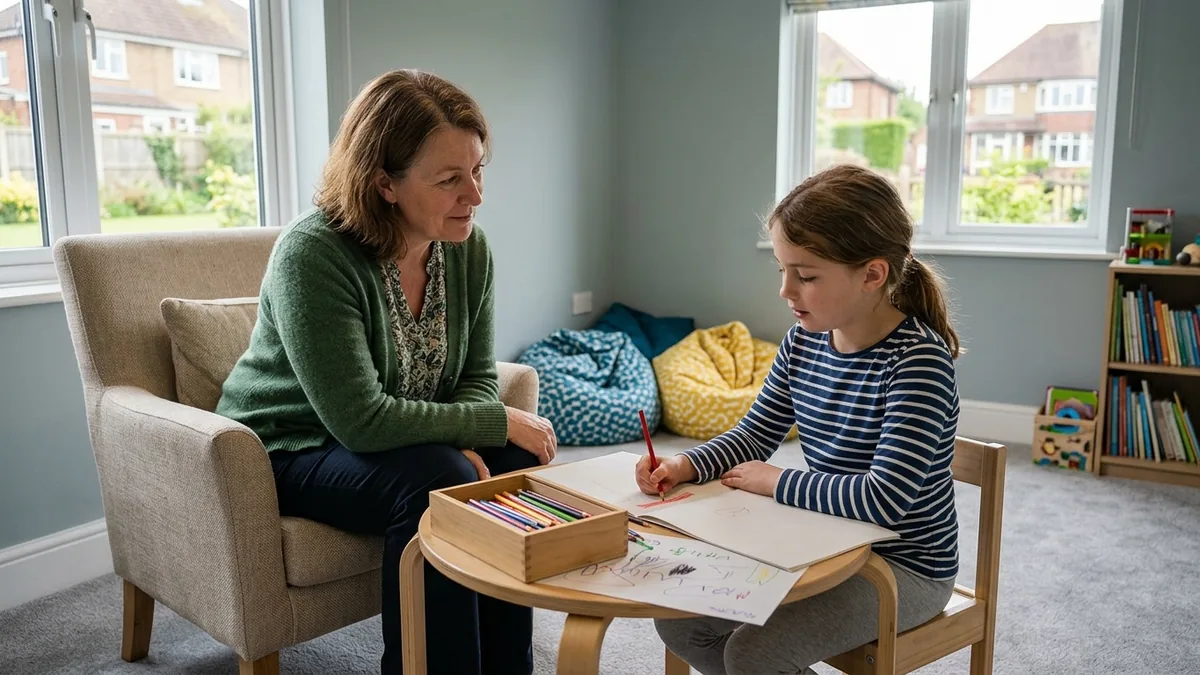
Child-inclusive mediation (sometimes shortened to CIM) is an optional extension of family mediation in which a mediator with specific additional training meets your child separately, hears how things look from their side, and then, with the child’s agreement, feeds the key messages back into the parents’ next session. The child never negotiates, never attends the adult sessions and never chooses between parents.
The thinking behind it is simple: arrangements are being made about the child’s life, so the child’s perspective is relevant evidence, and children usually know that decisions are being made. Research and practice experience both point the same way, that children cope better with separation when they feel informed and heard, and worse when they feel decisions simply happen to them. Hearing a child is not the same as burdening a child, and the structure of CIM is designed to keep those two things apart.
When is it offered, and at what age?
The Family Mediation Council’s position is that all children and young people aged 10 and above should be offered the opportunity to have their voices heard during mediation, where the case involves arrangements for them. In practice your mediator will raise it once the shape of the dispute is clear, typically after the first joint session. Younger children can sometimes take part too, at the mediator’s discretion, particularly where an older sibling is being seen.
Timing matters. CIM works best when parents have made progress on the broad framework but not yet fixed the detail, so the child’s input can genuinely influence the outcome rather than arriving after everything is settled. It is used most often in child arrangements mediation, on questions like weekly patterns, handovers, holidays and how a teenager’s social life fits around two households.
The law
When a court decides a dispute about a child, section 1 of the Children Act 1989 makes the child’s welfare the paramount consideration, and the welfare checklist requires the court to have regard to the child’s ascertainable wishes and feelings in the light of their age and understanding. Child-inclusive mediation gives parents a way to hear those wishes and feelings directly, without court proceedings or a Cafcass interview.
How a child-inclusive meeting works
Once both parents agree, the mediator sends the child their own invitation, usually a short letter or email written for their age, making clear that the meeting is the child’s choice. If the child accepts, they meet the mediator without either parent present, in person or by video, typically for around 45 minutes. Brothers and sisters can be seen together, separately, or both, depending on what they prefer.
The conversation is not an interview about who did what. Mediators trained in this work use open, low-pressure questions about the child’s week, school, friends and how the current arrangements feel, often with drawing or scaling exercises for younger children. The mediator is listening for what the child wants their parents to understand, not for a verdict on where they want to live.
At the end, the mediator and child agree exactly what will be passed on. At the parents’ next session the mediator relays those agreed messages and helps you both work out what, if anything, should change in your proposals as a result. The feedback often finds its way straight into the wording of the parenting plan.
Consent: both parents, and the child
Child-inclusive mediation needs three yeses. Both parents must agree before any invitation is sent, because involving a child over one parent’s objection would poison the process and put the child in an impossible position. The child must then accept the invitation freely; the FMC is explicit that there is no requirement for children to attend if they do not want to, and a decline changes nothing about the mediation itself.
Consent has to be genuine on all sides. A child coached by one parent about what to say, or leant on to attend, will usually be spotted quickly by an experienced mediator, and the meeting will do no good. The best preparation is a neutral, joint message: “we are both trying to sort things out fairly, someone independent would like to hear your side, it is completely up to you.” Our guide to talking to children about separation has age-by-age suggestions for conversations like this.
What the child says stays in the child’s control
The child’s meeting is confidential, and the feedback loop belongs to the child. Before anything is reported back, the mediator agrees with the child what the parents will be told, sometimes word for word. A child can share everything, a few chosen messages, or nothing at all. That control is what makes children willing to be honest: they can say “I hate Sunday handovers” without it becoming “she said she hates being with you”.
The one exception mirrors the rest of mediation: if anything in the meeting suggests the child or someone else is at risk of significant harm, the mediator must act on it, and children are told about this limit in age-appropriate terms at the start. The mediators who do this work hold specific child-inclusive training on top of their ordinary qualification, which is part of the standards framework described in our guide to mediator accreditation.
What child-inclusive mediation is not
It is not handing the decision to the child. The FMC’s guidance is blunt on this point: decision-making never passes to the child, and parents always retain responsibility. A twelve-year-old who says they want fewer midweek moves is giving you information; what you do with it remains an adult decision, weighed alongside work patterns, school runs and everything else.
It is not therapy or counselling. One conversation with a mediator can help a child feel heard, but a child who is struggling emotionally may need ongoing support from school counselling or CAMHS, and a good mediator will say so rather than stretch the meeting into something it is not.
And it is not evidence-gathering for court. Nothing from the child’s meeting produces a report, a recommendation or a statement for proceedings. If your case ends up in court, the child’s voice reaches the judge through Cafcass instead. CIM belongs to the world of agreement, not litigation.
Does hearing children help arrangements last?
Mediators offer child-inclusive work because of what they see afterwards: parents who have heard their child’s actual views, rather than each parent’s version of them, argue less about what the child “really wants”, and the arrangements they make tend to need less renegotiation. Australian research by Jennifer McIntosh and colleagues, which strongly influenced practice in England and Wales, found that child-inclusive approaches were associated with more durable agreements and better outcomes for children than parent-only mediation.
A child’s input also future-proofs a plan in a way adults struggle to. Parents design arrangements for the children they have now; children flag the things that are about to change, the friendship group, the new school, the Saturday job. Building in their perspective, and a review point, saves many families a second round of mediation two years later.
Because child-inclusive mediation happens within a child arrangements case, the government’s family mediation voucher scheme, worth up to £500 per family, can help with the overall cost of the mediation. The voucher is not means-tested, though it does not cover the MIAM.
Nina and Paul, from Exeter, had spent two sessions deadlocked over their daughter Freya, aged 11: Nina proposed a strict week-on, week-off pattern, Paul wanted the existing every-other-weekend routine extended. Both insisted Freya agreed with them. With both parents’ consent, Freya met the mediator one Tuesday after school. What she asked the mediator to pass on surprised them both: she did not mind which house she slept in, but she wanted her netball training on Mondays and Thursdays to be fixed points that never moved, and she hated packing a bag every few days. The final plan ran Thursday to Thursday, built around netball, with a duplicate set of school kit at each house so nothing needed packing.
Neither parent’s proposal survived contact with Freya’s actual priorities, and the plan they made instead was still working when they reviewed it a year later.
Frequently asked questions
Will my child be asked to choose between us?
No. Mediators trained in child-inclusive work never ask a child to pick a parent or a home. The questions are about the child’s everyday experience: school, friends, routines, and how the current arrangements feel. The purpose is to give you both better information, not to make the child responsible for the outcome.
My ex-partner wants child-inclusive mediation and I am not sure. Do I have to agree?
No. Both parents must consent before a child is invited, so it cannot happen over your objection. Talk your concerns through with the mediator privately; common worries, like the child being coached or upset, are exactly what the format is designed to guard against. If you still say no, the mediation simply continues without it.
Will we be told everything our child says?
No, and that is deliberate. The mediator agrees with your child exactly what will be fed back, and only those messages are shared at your next session. The rest stays private, unless something suggests a risk of significant harm, in which case the mediator must act. That privacy is what lets children speak honestly.
Is there an extra cost for the child’s meeting?
Usually yes. The child consultation is normally charged as an additional session, and prices vary between services, so ask when you book. Because it takes place within a child arrangements case, the £500 family mediation voucher can help with the overall cost of mediation where your case qualifies.
Can any family mediator see our child?
No. Direct consultation with children requires specific additional training on top of a mediator’s ordinary qualification, covering how to talk with children, safeguarding and managing feedback. If your own mediator does not hold it, they can bring in a colleague who does for the child’s meeting while continuing to run your joint sessions themselves.
Sources
- Family Mediation Council, Can my children be involved in sessions?, the offer to children aged 10 and over, consent, feedback and decision-making staying with parents (accessed July 2026).
- Family Mediation Council, Code of Practice, standards and training requirements for mediators, including work involving children (accessed July 2026).
- Children Act 1989, section 1, the welfare principle and the child’s ascertainable wishes and feelings (accessed July 2026).
- GOV.UK, Making child arrangements through mediation, mediation as the route for agreeing arrangements without court (accessed July 2026).
- GOV.UK, Family mediation voucher scheme, the £500 contribution for child arrangements cases (accessed July 2026).
- Cafcass, how children’s voices are heard where a case goes to court instead (accessed July 2026).