
Family mediation success rates: what the data shows
Key facts
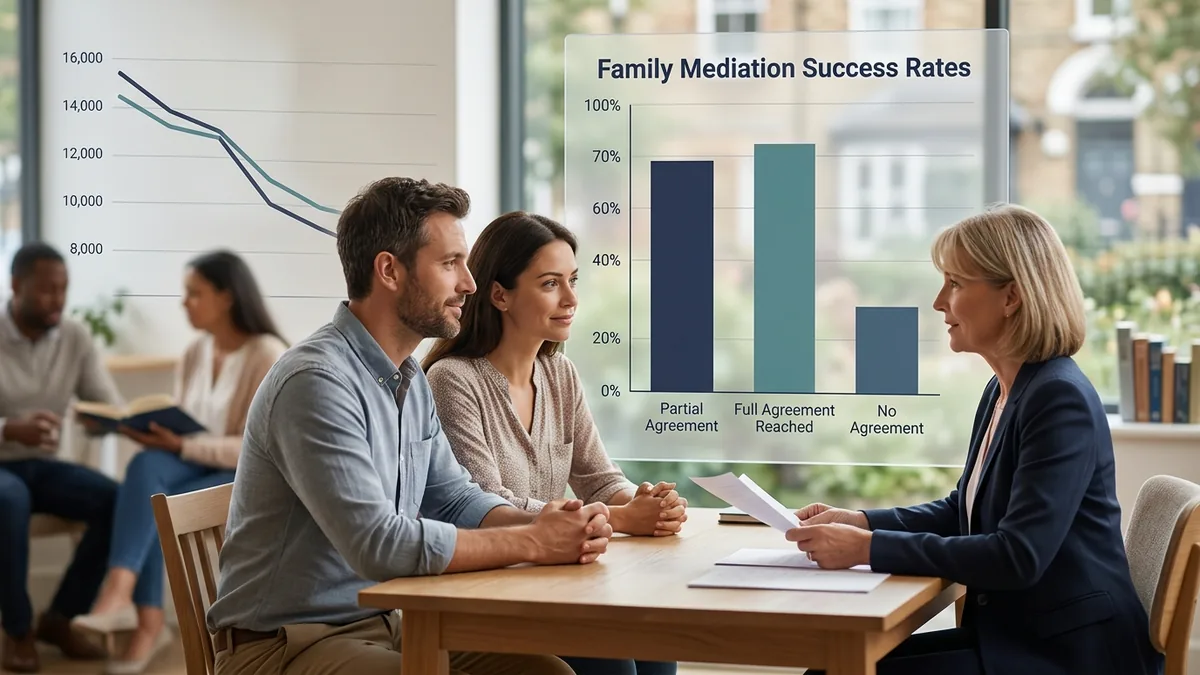
- Family mediation works for most people who try it: in the Ministry of Justice analysis of the voucher scheme, 77% of families reached a whole or partial agreement.
- 69% of those families either avoided court altogether or went only to obtain a consent order.
- Success is not all or nothing. A partial agreement that settles the children, or narrows the finances, still counts, and still saves time and cost.
- The biggest factors that raise the chance of agreement are willing engagement, full financial disclosure and proper safety screening.
- Set against a private law caseload that rose to 40,971 open cases by the end of March 2026, mediation is the clearest chance to keep families out of court.
A fair question to ask before you start is simple: does family mediation actually work, and how often? The most reliable recent answer comes from the government’s own study of the Family Mediation Voucher Scheme, because those were real, funded cases tracked from start to finish rather than a provider’s own marketing. In that analysis, 77% of families reached a whole or partial agreement, and 69% either stayed out of court or used it only to approve what they had already agreed.
This page explains what those figures mean, what counts as a successful outcome, and which factors make agreement more likely. It also sets the results against the rising demand on the family courts, because the distance between the two is where mediation earns its place. For the process itself, see our guide to how family mediation works.
This page is part of our family mediation statistics hub, where every figure is dated and sourced.
What the voucher scheme data found
The Ministry of Justice analysed the first year of the voucher scheme, which funded roughly 7,214 families with up to £500 each towards mediation about children. Because every one of those cases was recorded, the outcomes give a clearer read on how mediation performs than smaller or self-reported samples. The headline results were strong and have held up through repeated extensions of the scheme.
| Outcome | Share of families | What it means |
|---|---|---|
| Reached whole or partial agreement | 77% | Settled everything, or settled some issues and narrowed the rest |
| Avoided court, or consent order only | 69% | Did not need a contested hearing to resolve their dispute |
| Families in the analysis | About 7,214 | Funded through the first year of the scheme |
These numbers matter because they measure funded, tracked cases rather than opinion. They are consistent with what accredited mediators have long reported, that most people who genuinely engage reach at least a partial agreement, and that only a minority need a judge to decide for them.
It is worth being clear about what the 69% figure captures, because it is often the more useful of the two. Reaching agreement is one thing; staying out of court is what actually saves families the time, cost and stress of litigation. That more than two thirds of funded families either avoided court entirely or used it only to rubber-stamp a consent order shows mediation doing exactly what it is meant to do, keeping disputes out of a system that is under real strain.
What counts as success in mediation?
Success in mediation is not a single, all-or-nothing event. Reaching agreement on some issues, even if not every issue, is a real result. It narrows what is left, cuts the cost and time of anything that does go to court, and usually leaves a working relationship for future decisions about the children. A case that settles where the children live but leaves one pension point open has still moved a very long way.
| Type of outcome | Counts as success? | Typical next step |
|---|---|---|
| Full agreement on children and finances | Yes | Parenting plan and a consent order to make finances binding |
| Agreement on children only | Yes, in part | Continue on finances, or resolve them separately |
| Agreement on finances only | Yes, in part | Consent order lodged with the court for £62 |
| Issues narrowed but not settled | Partly | A shorter, cheaper court application on fewer points |
| No agreement reached | No | Mediator can sign the court form to allow a C100 or Form A |
Reading the 77% figure with this in mind is important. It combines families who resolved everything with families who resolved part of their dispute, and both groups are better off than if they had gone straight to a contested hearing. Even where mediation does not produce a full settlement, the mediator can sign the court form that lets a C100 or Form A application proceed, so nothing is lost by trying.
Thinking of success as a spectrum rather than a pass or fail also changes how you approach the sessions. There is no need to hold out for a perfect, all-or-nothing outcome. Settling the parts you can agree on, and being honest about the parts you cannot, is often the fastest way to reduce a dispute to something manageable. Many families find that once the easier points are settled, the harder ones look smaller too, and a case that seemed destined for court resolves after all.
What makes agreement more likely
No two separations are the same, and the chance of agreement depends heavily on how both people approach the table. The factors below are the ones mediators and researchers point to most often.
| Factor | Why it raises the chance of agreement |
|---|---|
| Both people engage willingly | Mediation is voluntary, so it works best when neither side is dragged to it |
| Full and honest disclosure | An agreement on finances only holds if both people know the true figures |
| Proper safety screening | Separate MIAM screening filters out cases where mediation would not be safe or fair |
| A focus on the future, not the past | Planning for the children ahead tends to settle faster than reliving old grievances |
| Realistic legal information | Knowing the likely range of outcomes helps both people compromise sensibly |
| Starting early | Trying to agree before positions harden makes settlement more likely |
Why willingness matters
Mediation cannot succeed if one person refuses to take part, because it is voluntary by design. If that happens to you, see our page on what to do when an ex refuses mediation, which explains how the MIAM certificate still lets you apply to court.
Since 22 April 2014, section 10 of the Children and Families Act 2014 has required most people to attend a MIAM before applying to court about children or finances, unless an exemption applies. The point of that first meeting is to check whether a case is suitable for mediation and to screen for safety, which is one reason engaged cases settle so often.
The diversion opportunity: success rates against a rising caseload
The value of a 77% agreement rate is clearest when you set it beside what is happening in the courts. In January to March 2026, private law case starts rose 16% to 15,534, and the open caseload climbed 11% to 40,971 cases still waiting at the end of March. Every family that reaches agreement in mediation is one that does not add to that queue.
| Measure | Latest figure | Direction |
|---|---|---|
| Families reaching agreement in mediation | 77% | Steady across scheme extensions |
| Private law case starts (Jan to Mar 2026) | 15,534 | Up 16% on the year |
| Open private law caseload (end March 2026) | 40,971 | Up 11% on the year |
| Average time to a private law disposal | 35 weeks | Down 5 weeks on the year |
Read together, the picture is straightforward. Demand on the courts is rising faster than the courts can clear it, yet most families who try mediation reach agreement in a fraction of the time. That contrast is why the courts and the non-court dispute resolution rules now expect families to have tried mediation first. For the full court picture, see our family court delays page.
Why reported success rates vary
You will see different success figures quoted in different places, and the reason is usually what is being measured and who is counted. Some figures count only cases that reached full agreement; others, like the voucher analysis, include partial agreement. Some samples are small or drawn from a single provider, while the voucher study is large, funded and independently analysed, which makes it one of the most reliable recent measures. Cases involving unmanaged conflict, or where mediation is not suitable, are less likely to settle, which is exactly why screening exists before mediation begins.
A separated couple came to mediation about their two children after months of stalled messages. Over three joint sessions they agreed a week-to-week schedule, holiday sharing and how to handle school events, and wrote it into a parenting plan. They did not resolve one point about a future house move, but they agreed to return to mediation if it arose. On the voucher scheme measure this counts as a partial agreement, and it kept a contested hearing off the court list entirely.
Success measured against court outcomes
Another way to judge whether mediation works is to compare its outcomes with what happens in court. A contested hearing produces a decision, but it is a decision imposed on the family by a judge, and research consistently finds that arrangements people design themselves tend to last longer and break down less often than those ordered against their wishes. A 77% agreement rate therefore does more than resolve the immediate dispute; it produces settlements the family is more likely to stick to.
There is also a difference in what each route can achieve. A court order fixes the point in dispute, but it rarely mends the working relationship between two parents who will keep making decisions about their children for years. Mediation, by contrast, is built to leave that relationship in a better state, which is part of why so many families who reach even a partial agreement come back to resolve later questions the same way rather than returning to court.
What this means if you are weighing up mediation
The data supports a simple conclusion. Most people who genuinely try mediation reach at least a partial agreement, and most avoid a contested court case. The odds improve when both people engage, disclose fully and focus on workable arrangements for the future. Even in the minority of cases that do not settle, mediation narrows the issues and produces the certificate needed to apply to court, so it is rarely wasted effort.
If you are starting out, the natural first step is a MIAM, where a mediator explains your options and checks whether mediation is right for you. From there, our guides to child arrangements through mediation and financial mediation set out what to expect. None of this replaces advice on your own circumstances, but it should help you judge the odds before you begin.
Frequently asked questions
How often does family mediation succeed?
In the Ministry of Justice analysis of the voucher scheme, 77% of families reached a whole or partial agreement and 69% avoided court or went only for a consent order. Those figures cover funded, tracked cases, which makes them among the most reliable recent evidence.
Does partial agreement count as success?
Yes. Settling some issues narrows the dispute, cuts cost and time, and is treated as a real outcome. Many families resolve the children’s arrangements even where the finances take longer to agree.
What makes mediation more likely to work?
Both people engaging willingly, disclosing their finances fully, and focusing on the future rather than the past. Proper safety screening before mediation also filters out cases where it would not be safe or fair.
Why do success rates differ between sources?
Because they measure different things and different groups. Some count only full agreement, others include partial agreement, and sample sizes vary. The voucher analysis is a large, funded and tracked sample.
Is mediation still worth trying if we might not agree?
Usually yes. Even where full agreement is not reached, mediation often narrows the issues, and the mediator can sign the court form that lets you apply. Very little is lost by trying it first.
How does mediation compare with going to court?
Most families settle in mediation within a few sessions, while private law court cases averaged 35 weeks to a disposal in early 2026 and the open caseload rose to 40,971. Mediation is usually faster, cheaper and less adversarial.
Who decides if a case is suitable for mediation?
An accredited mediator assesses suitability at the MIAM, screening for safety and checking that both people can take part fairly. If it is not suitable, the mediator says so and can provide the certificate for court.
Sources
- Ministry of Justice, Family Mediation Voucher Scheme analysis, gov.uk. Accessed 9 July 2026.
- Ministry of Justice, Family Court Statistics Quarterly: January to March 2026, gov.uk. Accessed 9 July 2026.
- Family Mediation Council, Mediation voucher scheme, familymediationcouncil.org.uk. Accessed 9 July 2026.